Healing & Sleep
Healing & Sleep Peptide Research
Tissue repair, immunomodulation, growth hormone axis, and sleep peptide research.
Healing & Sleep Peptide Research at Genevium
Recovery is one of the most active areas of contemporary peptide research. Across regenerative medicine, sports science, and inflammation biology, a growing body of literature examines how short-chain peptides modulate the cellular and biochemical processes that underlie tissue repair, immune regulation, and the restorative phases of physiological recovery, including sleep.
The Healing & Sleep category on the Genevium Research Hub organizes this research landscape into four functional sub-domains: tissue-repair peptides, immunomodulatory peptides, growth hormone axis peptides, and sleep-and-restoration peptides. Articles in this category cover compound mechanisms, comparative research, and the methodology considerations that govern rigorous laboratory work with these peptides.
Articles
Compound Research
Mechanism of action and integrated pharmacology research on individual research compounds in the healing and sleep peptide category.
Healing & Sleep
What Is BPC-157? Research Overview of the Pentadecapeptide
Mechanism of action research on BPC-157, the gastric-derived pentadecapeptide. Covers the amino acid sequence, proposed mechanisms including nitric oxide and angiogenic pathway engagement, model systems, and methodology considerations for tissue-repair research.
Healing & Sleep
What Is TB-500? Research Overview of the Thymosin Beta-4 Fragment
Mechanism of action research on TB-500, the synthetic Thymosin Beta-4 fragment. Covers the LKKTETQ active core, G-actin sequestration mechanism, cellular migration effects, model systems, and methodology considerations for tissue-repair research.
Healing & Sleep
What Is CJC-1295? GHRH Analog Research
Mechanism of action research on CJC-1295, the long-acting synthetic GHRH analog. Covers the 29-amino-acid sequence with four stability substitutions, the Drug Affinity Complex modification and albumin binding mechanism, GHRH receptor signaling and preserved GH pulsatility, model systems, and methodology considerations for growth hormone axis research.
Healing & Sleep
What Is Ipamorelin? Ghrelin Agonist Research
Mechanism of action research on Ipamorelin, the synthetic pentapeptide ghrelin receptor agonist. Covers the five-residue sequence with non-natural amino acids, ghrelin receptor signaling via calcium mobilization, the selective endocrine profile that distinguishes Ipamorelin from related compounds, model systems, and methodology considerations for growth hormone axis research.
Comparative Studies
Side-by-side analyses of healing and sleep peptide research compounds, focused on combination methodology and parallel-arm experimental designs.
Healing & Sleep
BPC-157 and TB-500 Research: Mechanisms, Synergy, and Combination Methodology
In-depth research overview of BPC-157 and TB-500, including the structural origins of each peptide, proposed mechanisms documented in the published research, areas where their pathways converge, and methodology considerations for combination experimental work.
Healing & Sleep
CJC-1295 vs Ipamorelin: Growth Hormone Secretagogue Research Comparison
In-depth research comparison of CJC-1295 and Ipamorelin, covering GHRH receptor versus ghrelin receptor pharmacology, the half-life and pulsatility differential between the two compounds, and methodology considerations for parallel-arm comparative experimental designs.
Pharmacology Fundamentals
Educational and foundational research articles on the receptor pharmacology, signaling pathways, and methodology that underpin healing and sleep peptide research.
Healing & Sleep
Recovery Peptide Research: Tissue Repair, Inflammation, and Restoration
A research framework for the recovery peptide landscape covering tissue-repair peptides (BPC-157, TB-500), immunomodulatory peptides (KPV, Thymosin Alpha-1, LL-37), and sleep-and-restoration peptides (DSIP, Epitalon, Pinealon). Includes methodology considerations and quality standards.
Healing & Sleep
Lyophilized Peptides: Methodology, Storage, and Stability for Research Applications
Methodology reference on the freeze-drying process applied to peptides, the rationale for lyophilization, storage temperatures and shelf life expectations, and the visual and analytical quality indicators researchers use to assess lyophilized material.
Compounds in This Domain
Healing and sleep peptide research covers compounds across four distinct functional categories. Each operates through distinct mechanisms and serves different research applications.
| Category | Representative Compounds | Research Focus |
|---|---|---|
| Tissue-Repair Peptides | BPC-157, TB-500 (Thymosin Beta-4 fragment) | Direct effects on damaged tissue and the cellular machinery responsible for repair, including tendon, ligament, muscle, and gastrointestinal tissue research. |
| Immunomodulatory Peptides | KPV, Thymosin Alpha-1, LL-37 | Effects mediated through immune cell modulation rather than direct tissue action, including anti-inflammatory and antimicrobial research applications. |
| Growth Hormone Axis Peptides | CJC-1295, Ipamorelin | Effects on the pituitary somatotroph axis through GHRH receptor activation (CJC-1295) or ghrelin receptor activation (Ipamorelin). Includes growth hormone release pharmacology and downstream IGF-1 axis research. |
| Sleep-and-Restoration Peptides | DSIP, Epitalon, Pinealon | Circadian regulation, slow-wave sleep architecture, and pineal-axis function. |
Quality and Methodology
Healing and sleep peptide research is sensitive to compound purity and identity confirmation. Tissue-repair experiments using compounds of unverified purity introduce confounding variables that compromise the interpretability of results. Without analytical verification, results cannot be replicated and conclusions cannot be trusted. Compound purity and identity confirmation are not optional in this category. They are the line between research that replicates and research that does not.
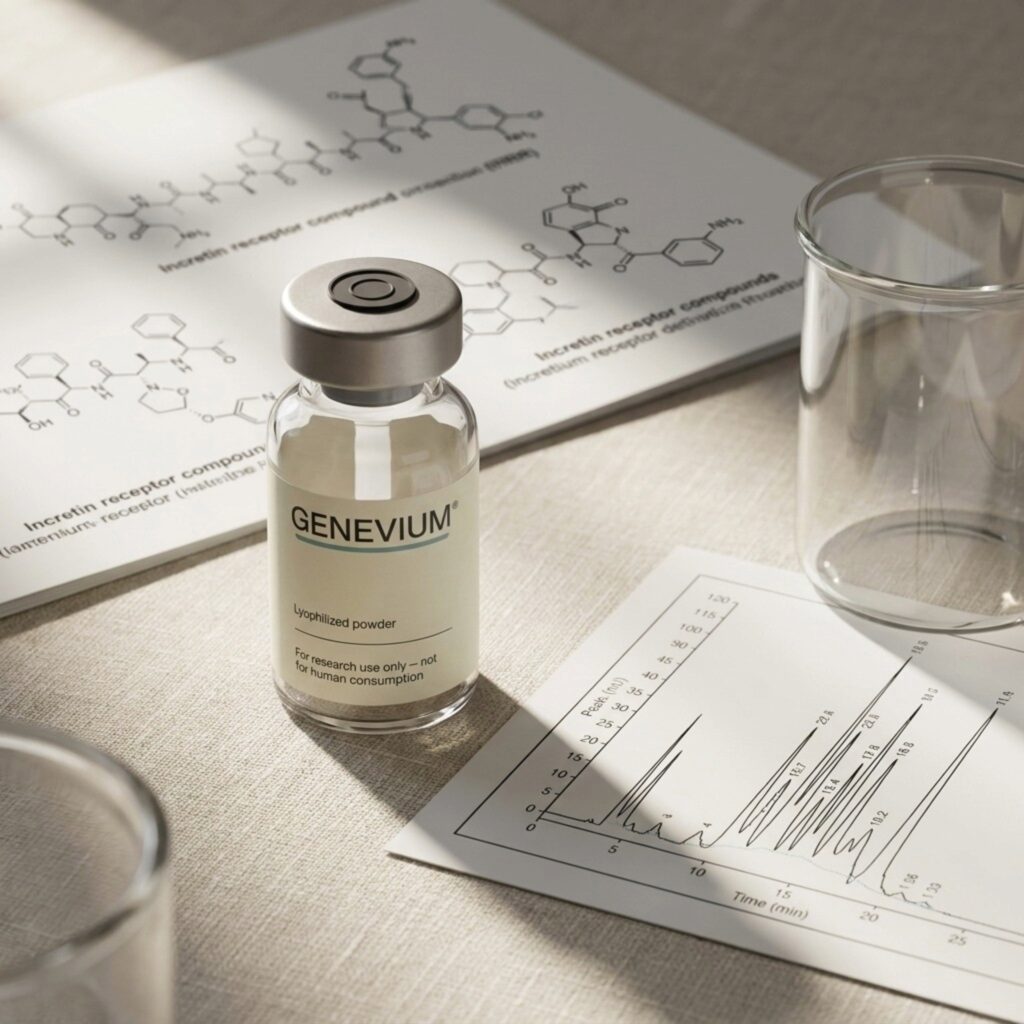
Genevium publishes batch-specific Certificates of Analysis for every research peptide. Each compound is verified at 99% or greater purity by reverse-phase HPLC and confirmed for identity by mass spectrometry. Every Certificate of Analysis is retrievable by batch number on the COA Lookup page.
For full methodology and quality standards documentation, see the Quality and Testing page. For solution preparation across these compounds, the peptide reconstitution calculator on the Research Hub calculates concentrations for any lyophilized quantity.
Research Peptides Available
For laboratory research applications, Genevium stocks the following research-grade peptides relevant to this category, each with batch-specific Certificate of Analysis and 99% or greater purity confirmation by HPLC and mass spectrometry.