✓ ≥99% HPLC-verified purity
✓ Third-party tested with batch-specific COA
✓ Available: 3-vial kit (70mg total)
✓ For laboratory research use only

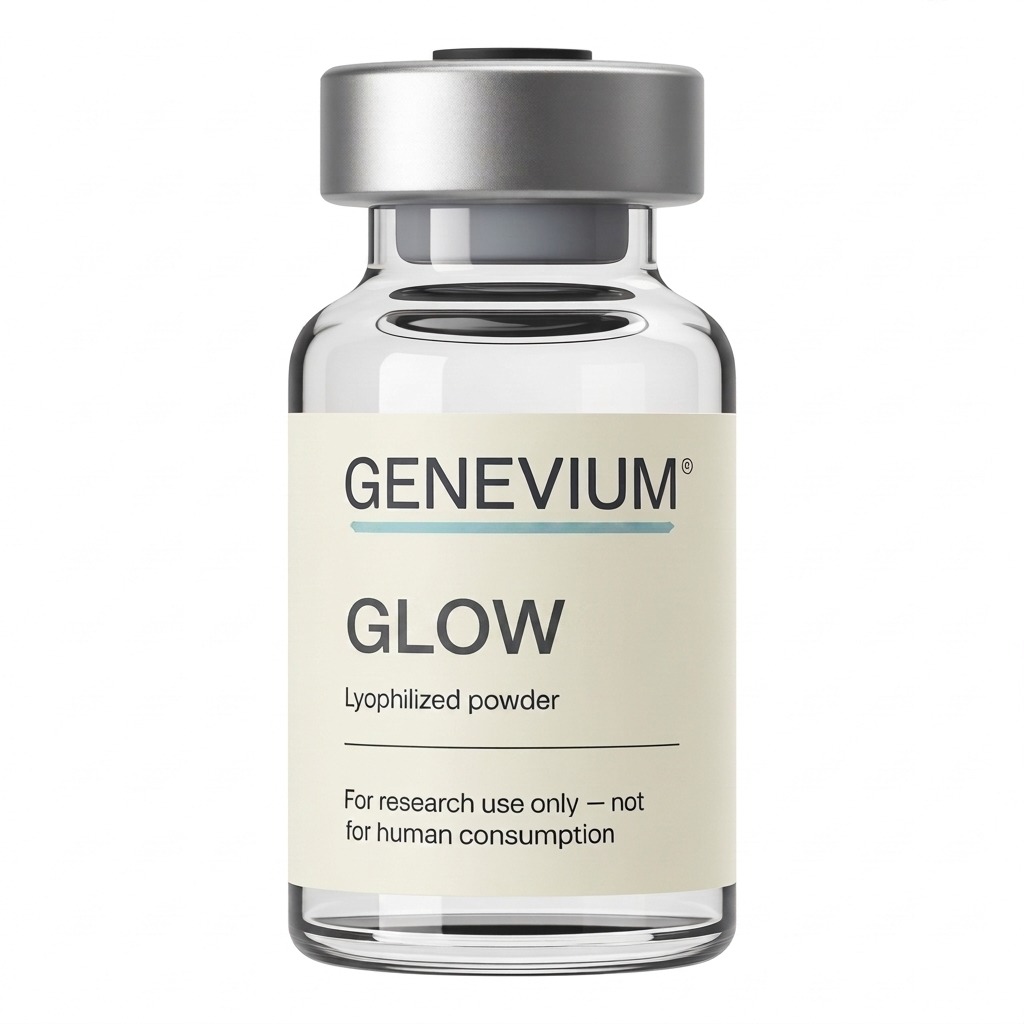
GLOW-70mg
$149.00
GLOW-70mg
Research Overview
Glow-70mg is a three-peptide research kit containing GHK-Cu (Glycyl-L-Histidyl-L-Lysine Copper), TB-500 (Thymosin Beta-4 fragment), and BPC-157 (Body Protection Compound 157). Each compound is supplied as a lyophilized powder in an independently sealed sterile vial, allowing investigators to reconstitute each peptide separately or together according to specific experimental requirements.
This kit is formulated for investigators studying peptide interactions across dermal, cytoskeletal, and gastrointestinal research models. All three peptides are documented in peer-reviewed literature for distinct roles in extracellular matrix biology, cellular signaling, and tissue organization research, making the combination useful for multi-pathway studies that examine how research peptides with complementary mechanisms behave when administered in parallel rather than as isolated single-compound interventions.
For broader context on the recovery peptide research landscape and how BPC-157 and TB-500 fit into tissue-repair research, see Recovery Peptide Research. For comparative research on the BPC-157 and TB-500 components specifically, including the methodological basis for combination studies, see BPC-157 and TB-500 Research.
Scientific Background
GHK-Cu is a copper-binding tripeptide studied for its role in collagen, elastin, and glycosaminoglycan synthesis in dermal fibroblast models. For mechanism research and model-system applications, see GHK-Cu Research.
TB-500, the actin-binding fragment of Thymosin Beta-4, is investigated for its role in cytoskeletal organization, cell migration, and angiogenic signaling. For the dedicated single-compound overview, see What Is TB-500.
BPC-157, a stable gastric pentadecapeptide, is studied for its cytoprotective properties across gastrointestinal and endothelial tissue models. For the dedicated single-compound overview, see What Is BPC-157.
Together, these three compounds represent distinct research avenues — extracellular matrix biology, cytoskeletal dynamics, and mucosal cytoprotection — within a single multi-pathway research kit.
Kit Composition
- GHK-Cu: Copper-binding tripeptide
- TB-500: Thymosin Beta-4 fragment
- BPC-157: Stable gastric pentadecapeptide
- Total Peptide Content: 70mg combined
- Purity (each component): ≥99% (HPLC verified)
- Format: Lyophilized powder
- Container: 3mL sterile vial (each peptide)
- Storage: Refrigerated (2 to 8 degrees Celsius)
Reconstitution and Storage
Each peptide in the Glow-70mg kit is supplied as lyophilized powder in an independently sealed vial. Reconstitution is performed by adding bacteriostatic or sterile water directly to each vial according to the volume protocol used in the specific research application. Because each compound is sealed separately, investigators retain full control over reconstitution order, ratio, and timing across experimental arms.
Storage of lyophilized vials at minus 20 degrees Celsius preserves primary structural integrity and biological activity for two to three years for most well-prepared research peptides. Refrigerated storage at 2 to 8 degrees Celsius is acceptable for active inventory expected to be used within months. Once reconstituted, peptides return to aqueous-phase stability constraints and should be used within the documented stability window for each compound rather than relying on a generic timeline.
For a detailed treatment of the freeze-drying process, storage temperatures, shelf life expectations, and quality indicators researchers use to assess lyophilized material before reconstitution, see Lyophilized Peptides: Methodology and Stability.
Quality and Verification
Every Genevium batch is independently tested by third-party laboratories. Reverse-phase HPLC confirms purity. Mass spectrometry confirms identity. Nothing ships until each component clears a 99%+ purity threshold.
A batch-specific Certificate of Analysis is published for every kit and is retrievable by batch number on the COA Lookup page. For combination kits, the COA documents purity verification for each component independently rather than as a blended product.
Research Applications
Glow-70mg supports laboratory research where multiple peptide pathways are examined in parallel within a single experimental design. Common research contexts include extracellular matrix studies in fibroblast culture systems, cytoskeletal organization research using cell migration and actin polymerization assays, and tissue-repair model systems where cytoprotective and angiogenic mechanisms are studied in combination.
The independent-vial format supports both single-compound and multi-compound experimental arms in the same research project, which simplifies dose-effect characterization and allows researchers to vary the ratio of one compound to another without sourcing each peptide separately. For combination protocol design considerations, including the methodology rationale for studying these compounds together, the comparative research overview at BPC-157 and TB-500 Research covers the experimental design questions specific to multi-peptide work.
Frequently Asked Questions
What is included in the Glow-70mg kit?
The kit contains three independently sealed sterile vials, one each of GHK-Cu, TB-500, and BPC-157, supplied as lyophilized powder. Total combined peptide content across the three vials is 70mg. Each component is verified at 99%+ purity by HPLC with mass spectrometry identity confirmation, documented on a batch-specific Certificate of Analysis.
Can the three peptides be reconstituted in the same vial?
The kit ships with each compound in a separate sealed vial. Reconstitution into a combined working solution is possible at the working-solution stage if the research design calls for it. Reconstituting separately preserves the ability to vary ratios across experimental arms, which is the more common approach in multi-peptide research methodology.
How long do the peptides remain stable after reconstitution?
Once reconstitution buffer is added, peptides return to aqueous-phase stability constraints. Usable laboratory stability under refrigeration at 2 to 8 degrees Celsius is generally measured in weeks rather than months and varies by compound. Reconstituted material should be used within the documented stability window for each specific peptide. For methodology context, see the Lyophilized Peptides reference.
How is the purity of each component verified?
Each component is tested independently by third-party laboratories using reverse-phase HPLC for purity quantification and mass spectrometry for identity confirmation. The batch-specific Certificate of Analysis documents the analytical results for each compound separately rather than reporting a single blended figure. Researchers can retrieve the COA for the specific batch received via the COA Lookup page.
For laboratory solution preparation, the reconstitution calculator determines the bacteriostatic water volume required to achieve a target concentration for a given quantity of lyophilized peptide.
Research Use Only. Genevium peptides are intended strictly for laboratory research purposes. Not approved for human consumption, clinical, therapeutic, veterinary, or diagnostic use. Materials are supplied exclusively for qualified research and analytical applications. For the broader regulatory framework that governs research-use-only peptides, see What Research Use Only Actually Means.
| Dosage | 70mg |
|---|---|
| Composition | BPC-157 30mg + TB-500 25mg + GHK-Cu 15mg |
| Component CAS Numbers | BPC-157: 137525-51-0; TB-500: 77591-33-4; GHK-Cu: 49557-75-7 |
| Purity | ≥99% |
| Storage | Lyophilized powder: store at -20°C, protected from light. Reconstituted: store at 2–8°C, use within 28 days. |
Add a review
Be the first to review “GLOW-70mg”
Related products

RETA Triple Agonist
Price range: $129.00 through $209.00-
TB-500 10mg
$69.00 -
TIRZ GLP-1 / GIP
Price range: $99.00 through $149.00
Updating…
There are no reviews yet.